

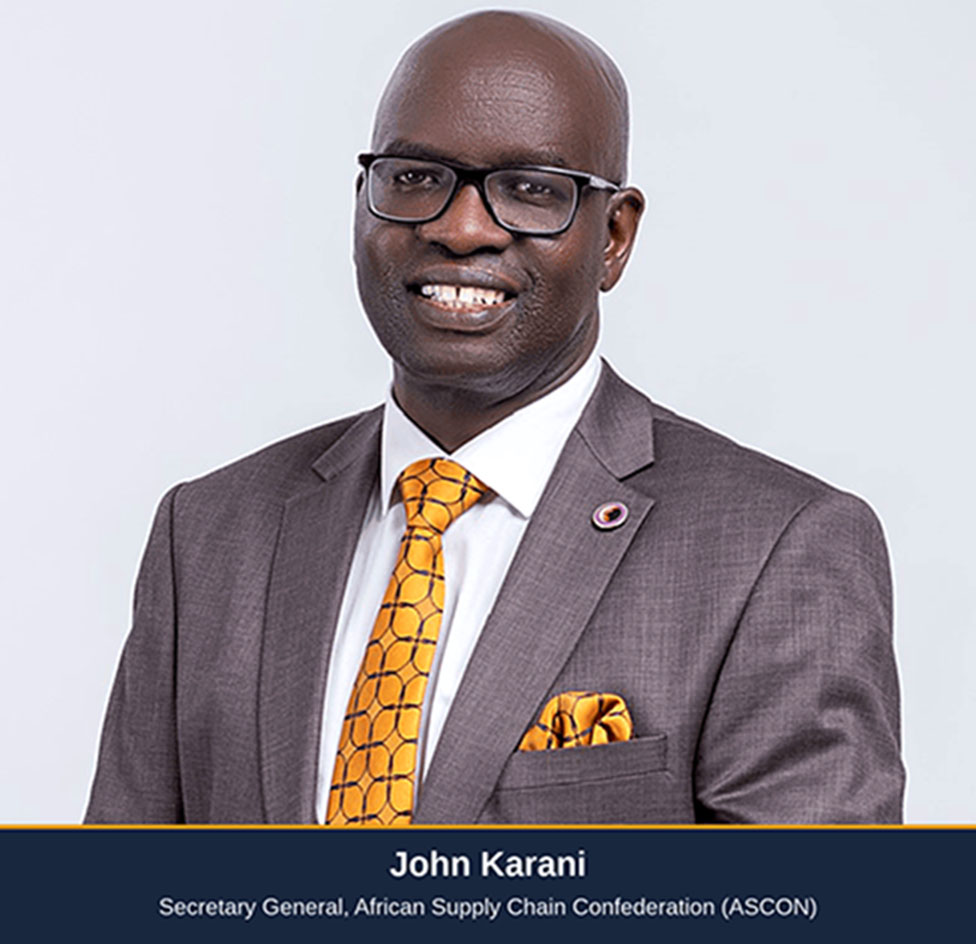
By John Karani, Secretary General of the African Supply Chain Confederation (ASCON)
Johannesburg – If we, as a continent, are to fully realise the benefits of the African Continental Free Trade Area (AfCFTA), which reduces barriers to intra-African trade, we must also consider the free movement of our citizens.
Currently, an African businessperson can face significant travel restrictions when entering another African country. According to the African Development Bank’s 2025 Africa Visa Openness Index (AVOI), more than half of all possible journeys between African countries require travellers to obtain a visa before departure.
The AVOI, produced jointly by the African Development Bank and the African Union (AU) Commission, shows that just 814 of the 2,862 possible journeys between Africa’s 54 internationally recognised countries can be undertaken without a visa. Another 585 allow visas on arrival, while 1,463 require travellers to obtain a visa or equivalent authorisation before travel, including through an e-visa. Notably, the number of routes requiring a visa before departure rose by 115 between 2024 and 2025.
This creates an economic problem: a tariff agreement that reduces taxes on trade does not necessarily help a business that cannot easily send its salespeople, technicians, managers or service providers into the destination market.
Two rulebooks
The dilemma is complicated by the fact that the AfCFTA covers trade in goods and services, investment and related economic integration, and only limited movement of people. This contrasts with the general free movement of people, which is covered by the separate AU Free Movement of Persons Protocol.
As a result, a country can participate in the AfCFTA without automatically granting visa-free access to citizens of every other AfCFTA country. The AU Free Movement of Persons Protocol, adopted in 2018, is not yet in force because it has not secured the required 15 ratifications.
There are regional differences. The Economic Community of West African States (ECOWAS) has a binding free-movement framework, yet in practice, implementation, border controls, residency rules and work-authorisation requirements still constrain actual mobility. The East African Community (EAC) also provides for free movement under its Common Market Protocol. The Southern African Development Community (SADC) has adopted a Protocol on the Facilitation of Movement of Persons, but it has not yet entered into force.
Counting the cost
The cost of these restrictions cannot be measured directly, but the scale of what is at stake can. Based on the International Monetary Fund’s (IMF) October 2026 World Economic Outlook projections, 18 of the 19 African countries whose citizens face more visa requirements within Africa than British passport holders account for about $1.3 trillion in gross domestic product (GDP).
This is about 35% of Africa’s overall GDP of $3.67 trillion, a substantial share of the continent’s economy that governments cannot afford to ignore when addressing barriers to free movement. The IMF does not provide projections for Eritrea, the nineteenth country on the list.
The IMF projects average economic growth of 4.1% across these countries in 2026, compared with 4.6% for Africa overall.
According to the African Export-Import Bank’s 2025 African Trade Report, intra-African trade accounted for just 14.4% of Africa’s total merchandise trade in 2024, down from 14.7% in 2023. This means 85.6% of trade was conducted with countries outside the continent.
Wait for no one
Governments do not need to wait for the AU Free Movement of Persons Protocol to enter into force before addressing these restrictions. The protocol itself provides for a phased approach, beginning with the abolition of visa requirements, followed by the right of residence and, ultimately, the right to establish businesses in other African countries.
In February 2025, the AU’s Executive Council encouraged member states to pursue free movement individually and collectively, while calling for stronger coordination between regional economic communities. This gives governments scope to introduce reciprocal visa waivers, simplify short-term business travel and extend existing regional arrangements to additional countries without waiting for continent-wide ratification.
Governments must also distinguish between allowing businesspeople to enter a country and permitting them to conduct business once there. Visa-free entry alone does not necessarily give a technician permission to undertake paid work, or a professional the right to provide regulated services across a border.
If the AfCFTA is to deliver on its promise of greater intra-African trade, governments need to give the movement of people the same attention they have given to the movement of goods and services. The people responsible for turning trade agreements into actual business must also be able to cross borders.
About the African Supply Chain Confederation
The African Supply Chain Confederation (ASCON) unifies professional African supply chain standards and networks. Through collaboration, education and advocacy, it fosters a cohesive ecosystem that empowers professional bodies and drives continental impact.
Wait for no one
Governments do not need to wait for the AU Free Movement of Persons Protocol to enter into force before addressing these restrictions. The protocol itself provides for a phased approach, beginning with the abolition of visa requirements, followed by the right of residence and, ultimately, the right to establish businesses in other African countries.
In February 2025, the AU’s Executive Council encouraged member states to pursue free movement individually and collectively, while calling for stronger coordination between regional economic communities. This gives governments scope to introduce reciprocal visa waivers, simplify short-term business travel and extend existing regional arrangements to additional countries without waiting for continent-wide ratification.
Governments must also distinguish between allowing businesspeople to enter a country and permitting them to conduct business once there. Visa-free entry alone does not necessarily give a technician permission to undertake paid work, or a professional the right to provide regulated services across a border.
If the AfCFTA is to deliver on its promise of greater intra-African trade, governments need to give the movement of people the same attention they have given to the movement of goods and services. The people responsible for turning trade agreements into actual business must also be able to cross borders.




 Loading …

Leave a Reply