

By Staff Reporter
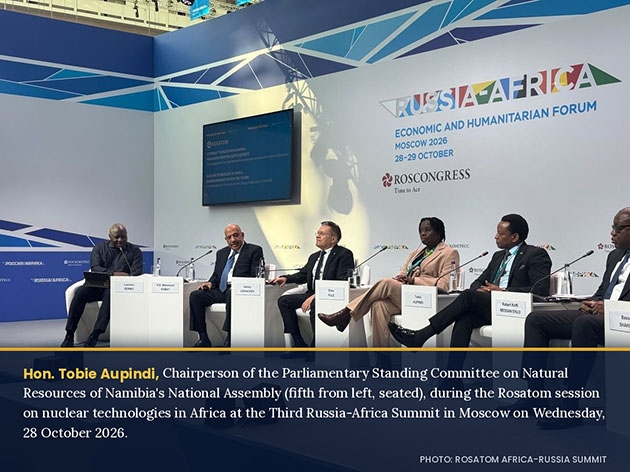
Hon. Tobie Aupindi, Chairperson of the Parliamentary Standing Committee on Natural Resources of Namibia’s National Assembly, has outlined his country’s approach to uranium and nuclear investment, saying Namibia welcomes only responsible partnerships centred on shared prosperity that respect its sovereignty.
He spoke on 28 October at a Rosatom-supported session on nuclear technologies in Africa, held during the Third Russia-Africa Summit in Moscow.
“Nuclear technology, industry and uranium mining are much more than just electricity generation. This is fully integrated economic and social corporate responsibility, and Namibia approaches this sector with absolute opportunity, cognisant of the fact that much larger economic benefit lies in it,” Aupindi said.
“That is why we welcome only responsible investment and partnership that is centred on shared prosperity and that respects our sovereignty,” he added.
He stressed the importance of value addition and mineral beneficiation, so that local communities and young people are trained and informed and share in the benefits of mining. The next generation of mineral extraction in Africa, he said, should be built around this principle.
As an example of engaging local communities and small suppliers, Aupindi pointed to the Wings project in the Omaheke Region, which involves local people in its value and supply chains. The sandstone-type deposit could yield 3,000 tonnes of uranium per year over a life of mine of at least 25 years.
Rosatom operates in Namibia through Headspring Investments, part of Uranium One Group, which is developing the Wings project. Namibia is one of the world’s leading uranium producers, accounting for around 11% of global output in 2022.
Rosatom Director General Alexey Likhachev told the session that the corporation operates in 29 of Africa’s 54 countries. “For African countries, nuclear technologies can become an effective tool for building national technological sovereignty: the ability to independently set development priorities, train their own specialists and master advanced industries,” he said.
The session was moderated by Lassina Zerbo, Chairman of the Board of the Rwanda Atomic Energy Board. Togo’s Minister of Mines and Energy Resources, Robert Koffi Messan Eklo, and Egypt’s Minister of Electricity and Renewable Energy, Mahmoud Esmat, also took part.




 Loading …

Leave a Reply