

By Mary Mashete and Kimmie Mikatazo
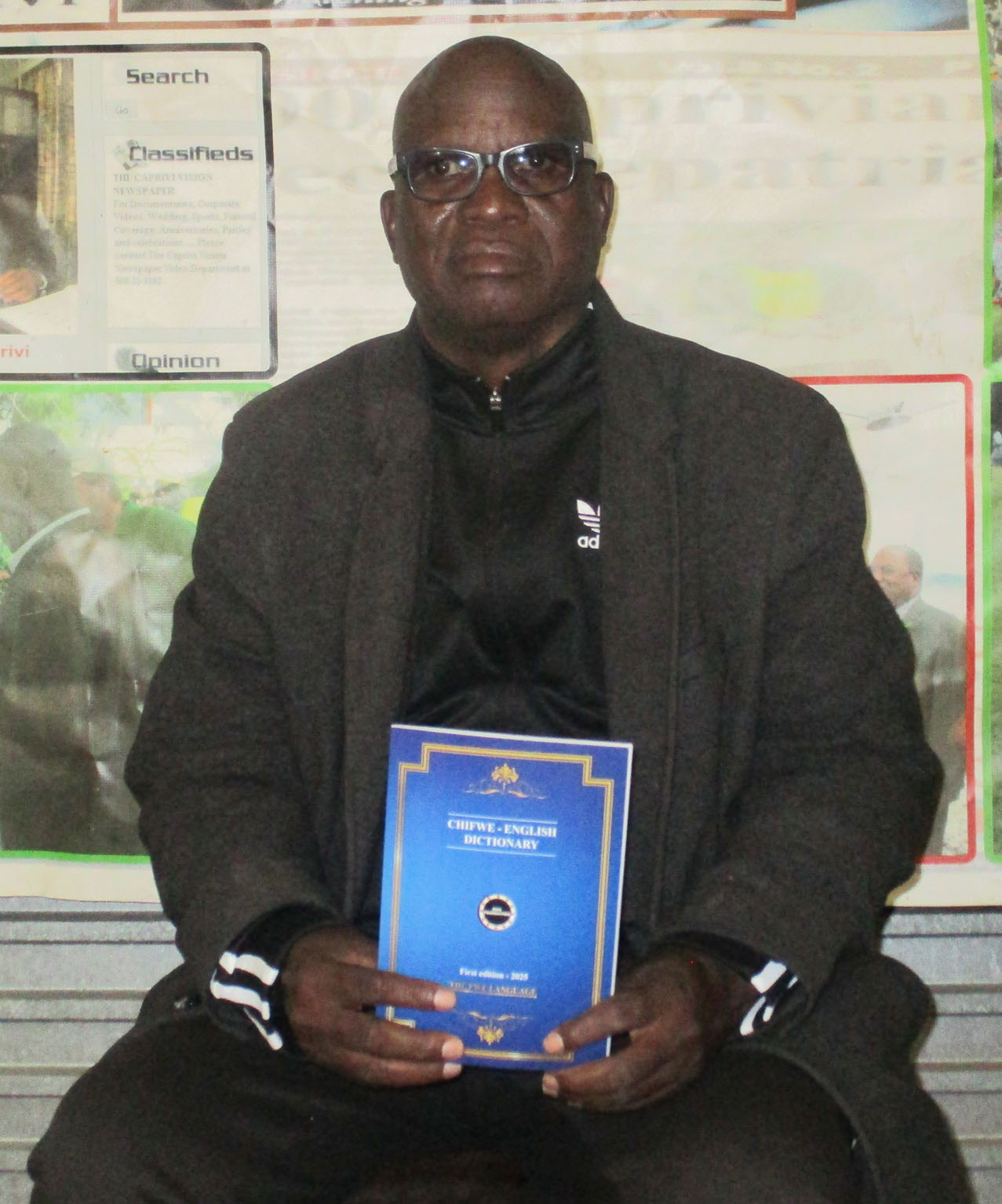
In a significant cultural achievement, and a major milestone in the preservation of indigenous languages was reached this year, when Prof. John Makala Lilemba, a seasoned educator and indigenous language advocate, unveiled a new dictionary aimed at preserving the Chifwe language.
The project, which took nearly a decade to complete, involved some major collaborations with family members and community elders to document words and proverbs that are at risk of disappearing.
The launch of the first-ever Chifwe-English dictionary, was compiled by a team of passionate language activists, who aim to preserve the Chifwe language and promote cultural identity across generations.
Professor Lilemba is a hybrid mufwe born in Sibbinda district, and hails from the Totela and Fwe clans, Lilemba’s journey in education began at Sibbinda Primary School in 1966 – 1973, After completing school at Sibbinda Primary and Kizito College, He went on to earn degrees from the University of the North (now University of Limpopo, Polokwane) in South Africa in 1983, where he obtained his Bachelor of Arts plus his Diploma for Education in 1984, and in 1990 he obtained his Degree Master in Education from the University of Manchester, United Kingdom.
Between 1984 and 1989, He taught at various schools including Ngweze and Caprivi Secondary School. His academic background and passion for language made him an ideal leader for the dictionary project.
In 2009 he graduated at the University of Namibia with his doctorate degree certificate as Doctor of Philosophy in Education.
His extensive career has included roles as an educational planner, counselor, lecturer and a philosopher of Education at various institutions, culminating in his recent efforts to capture the essence of Chifwe language and culture.
The initiative was led by Prof. Lilemba, and his cousins, Mr. Linus Chata, Mr. Rector Fenyeho, and Mr. Pac Mwanawina, who recognized the urgent need to document their language. They consulted with other experts and community members in Windhoek, gathering words and phrases that reflect the richness of the Chifwe language. Their efforts included traveling to villages to engage with elders, ensuring that the dictionary not only reflects contemporary usage but also to honour traditional expressions.
“We started this project as four brothers or cousins who saw the need to protect our language,” Lilemba explained.
“It was not an easy task. We consulted elders in the villages and colleagues in Windhoek, including Mr. Kenneth Mbanga, to gather words and verify meanings.”
Despite facing challenges in publication and distribution, the team succeeded in producing a hard copy of the dictionary this year 2025. Copies are now available at distribution centers in Katima Mulilo such as Bomac Auto Engineering and Zambezi Shell, Windhoek and Ondangwa, and efforts are underway to reach more communities through word-of-mouth and local media.
“This dictionary consists of 105 pages and serves as a crucial resource for the Chifwe-Speaking Community”
Lilemba told Caprivi Vision that “It is our first attempt to document our language comprehensively, and I am proud of what we have achieved.”
He however emphasized the importance of language preservation, noting that many languages face the threat of extinction. “Languages may completely disappear or assimilate into others. By creating resources like this dictionary, we can capture and preserve our heritage before it is lost,” he explained.
He believes that the dictionary will inspire similar initiatives. “There might already be dictionaries for Subiya or Yeyi, but groups like the Musanga or speakers of Thimbukushu in Kavango might also be encouraged to start their own,” he said.
He emphasizes that all languages are valuable. “No language is primitive. Every language is a golden gift from God,” he noted. “Language is not static. Even major languages like Chinese and English continue to evolve by borrowing from others.”
Lilemba encourages the Chifwe-speaking community to engage with the material. He invites feedback on the dictionary’s content, expressing hope for future editions that will continue to enrich the Chifwe language.
As Lilemba reflects on this milestone, he remains committed to fostering a deeper understanding and appreciation of ChiFwe culture through language, inspiring others to join in the effort to preserve their linguistic heritage.
“This dictionary is just the beginning. We hope it inspires more people to value, protect, and grow their languages,” He said.
In conclusion, the launch of the Chifwe-English dictionary marks a turning point for language preservation in Namibia. Prof. Makala Lilemba and his team now encourage students and researchers to build on this foundation by conducting further research and documentation.
To purchase a new copy of Chifwe – English Dictionary just visit the following Outlets:
KATIMA MULILO
Zambezi Shell
Cell: 0814409020
Cell: 0815759600
Bomac Auto Engineering
Cell: 0816510106.
Cell: 0818990600.
Tel: 066-254251.
WINDHOEK
Paca Shop
Cell: 0813561170.
Cell: 0816803066.
ONDANGWA
Sina Centre
Cell: 0818420883.
Cell: 0817564673.
RUNDU
CiCa Home
Cell: 0812359321.
END…
END…




 Loading …