

Kazakhstan just signed the deal that will power its first nuclear plant. The bigger question: could Namibia be next?
By Staff Reporter
One in every 25 light bulbs on Earth burns on Kazakh uranium. Now the world’s top uranium producer is going nuclear itself — and building the power plants to prove it. Thousands of kilometres away, Namibia is watching closely. It ranks among the world’s top three uranium producers, yet still buys much of its own electricity from abroad.
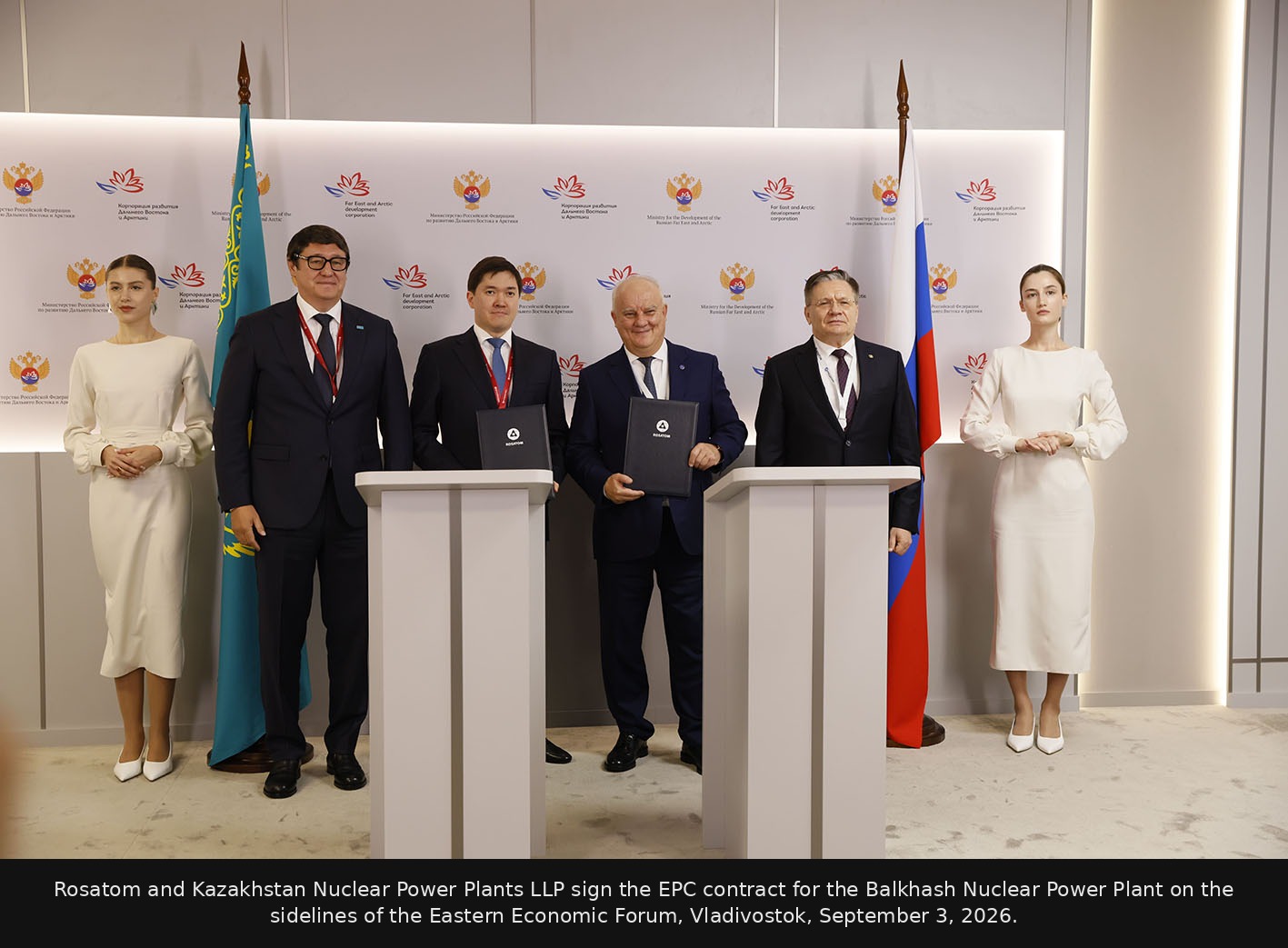
On September 3, on the sidelines of the Eastern Economic Forum in Vladivostok, Rosatom State Corporation and Kazakhstan Nuclear Power Plants LLP (KNPP) made it official. The two signed an engineering, procurement and construction (EPC) contract for the Balkhash Nuclear Power Plant — two Generation III+ VVER-1200 reactor units, 2,400 MW combined, rising near the village of Ulken on the shore of Lake Balkhash.
As leader of the international consortium behind the project, Rosatom will oversee the full build cycle — design, procurement, construction, commissioning and handover. The VVER-1200 reactor technology is already in operation or under construction in Russia, Egypt, Belarus, Turkey, Bangladesh, Hungary and China, with a 60-year design life that can be extended by a further 20 years. Kazakhstani officials have indicated construction could begin once site licensing is completed, with the first unit targeted for the mid-2030s.
Why It Matters for Namibia
The deal is being watched closely in Windhoek. Namibia produces around 12% of the world’s uranium, yet still imports up to 22% of its electricity, largely from South Africa. Erongo has long been the country’s uranium hub, while Omaheke is emerging as a new exploration frontier.
Kazakhstan’s path — mining and processing, nuclear education, then domestic power generation — offers a template for how a resource exporter can build out a full nuclear value chain. Namibia’s own energy choices remain a sovereign decision, on its own timeline. But the Kazakhstan project is a live example of the integrated model Rosatom applies across its international partnerships.
Jobs and Local Training
Localisation has been a consistent feature of Rosatom’s projects abroad. At Akkuyu in Turkey, more than 80% of the workforce are Turkish nationals. Belarus’ nuclear plant created over 1,000 skilled jobs on-site and more than 10,000 more in related services after coming online. In Egypt, the El Dabaa plant — Africa’s largest current nuclear construction site — employs thousands of workers, the majority of them Egyptian. In Kazakhstan, around 100 students are already studying nuclear disciplines at the MEPhI branch of Al-Farabi Kazakh National University, ahead of the plant’s construction.
Namibia-Russia Cooperation
Namibia and Russia have held discussions on cooperation in the peaceful use of nuclear energy, including joint work on uranium deposits and preparatory steps toward a framework intergovernmental agreement. Part of that cooperation is already under way: Headspring Investments, the Namibian operating arm of Rosatom’s Uranium One Group, is exploring for uranium in the Omaheke Region. Geological studies at its Wings project have identified a sandstone-hosted uranium deposit, with in-situ recovery under assessment as a possible extraction method.
Headspring Investments has also funded bursaries for Namibian university students in mining-related fields and a technical training programme for young people from the Leonardville area — initiatives the company says are aimed at building technical capacity ahead of Namibia’s future energy and industrial decisions.
This report draws on public statements from Rosatom and Kazakhstan Nuclear Power Plants LLP.




 Loading …
Leave a Reply