

The UN should launch an inquiry into military abuses of Myanmar’s minority Rohingya Muslims, because the government is incapable of carrying out a credible investigation, the UN’s rights envoy will tell the Human Rights Council next month.
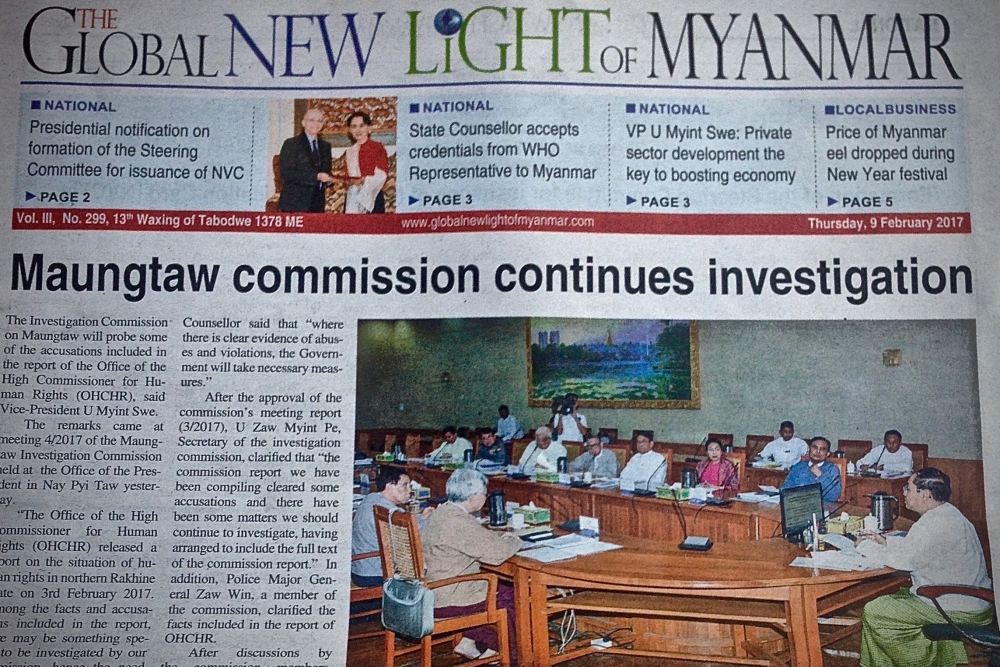
Yanghee Lee, the UN special rapporteur on human rights in Myanmar, told IRIN that she will urge member states to sponsor a resolution for a commission of inquiry when she presents her report to the Council in Geneva on 13 March.
“I never said in the past to a reporter what I plan to put in my report,” she said in a phone interview. “This time I am making this point: I will certainly be pushing for an inquiry, definitely, on the Rohingya situation.”
Rights groups have, over the past few years, been urging the UN to investigate reports of abuses against the Rohingya, a mostly stateless minority forced to live under an apartheid system. But the calls have become more urgent since reports of mass rapes, killings, and other atrocities began to emerge in early October, when the military launched counterinsurgency operations.
There is now unprecedented pressure for a UN-backed inquiry, which could find evidence that Myanmar’s military has committed crimes against humanity.
“A commission of inquiry would have been unthinkable six months ago, but serious momentum is growing daily,” said Matt Smith, chief executive officer of Fortify Rights, which has documented abuses of Rohingya. “The special rapporteur plays an essential role in helping UN member states understand what to do. They’ll strongly consider her recommendations.”
Mass exodus
More than 69,000 Rohingya have fled to Bangladesh since October, bringing with them horrific accounts of soldiers attacking their communities in Maungdaw, a township on the border that the military has kept under strict lockdown. Rohingya who made it to Bangladesh have recounted their experiences to groups such as Amnesty International and Human Rights Watch, which also analysed satellite images indicating that the military systematically burned villages.
A “flash report” issued last week by the UN Office of the High Commissioner for Human Rights added considerable weight to the push for an inquiry. Myanmar refused to allow UN investigators into Maungdaw, but 204 survivors in Bangladesh recounted harrowing experiences that allegedly included witnessing children being “slaughtered with knives”.
Myanmar’s civilian government, headed by Nobel Peace Prize winner Aung San Suu Kyi, has for months responded to such allegations with outright denials. But her administration appears to have softened its stance – if only slightly – in the wake of the OHCHR findings.
Spokespersons for the president’s office and the foreign ministry did not answer phone calls, but the government today printed a statement on the front page of the state-run Global New Light of Myanmar newspaper in response to the OHCHR report.
“The government of Myanmar considers the allegations contained in the report very serious in nature and is also deeply concerned about the report,” said the statement, which added that a government commission formed in December would investigate.
Few people outside the government have faith in that commission, which is headed by Myint Swe, a former lieutenant general who was only recently removed from the US sanctions list.
“It’s gone beyond the point of depending on the government to do a credible investigation,” said Lee, who met with the commission during her visit to Myanmar last month. “It didn’t even have a methodology of approaching this investigation,” she told IRIN.
A UN commission would include forensic specialists who would be tasked with determining whether crimes took place or not.
Doubts
Two questions loom large: Will one of the 47 member states in the Human Rights Council put forward a resolution to form a commission of inquiry? And, if so, will Myanmar cooperate?
Myanmar’s military is unlikely to allow access to investigators who would probably find evidence that its soldiers had committed crimes against humanity, according to a European diplomat who requested anonymity due to the sensitivity of the situation.
Aung San Suu Kyi’s government may be cooperative, but the military has ignored instructions over the past couple months from her administration to allow independent investigators, said the diplomat.
Aung San Suu Kyi’s administration has no control over the military and her influence on military matters is thought to be little if any.
The generals dissolved their junta in 2010, after almost half a century of unbroken military rule, and ushered in sweeping reforms that allowed Aung San Suu Kyi’s National League for Democracy to participate in elections after being violently repressed for decades. While the NLD won a majority in parliament, the military occupies key ministries in line with the constitution it wrote in 2008, which also gives it authority to carry out operations without civilian oversight.
However, the military would be under intense pressure to cooperate with a UN-backed commission of inquiry. Refusal by the government and military to cooperate with the UN would strip away much of the credibility Myanmar has gained internationally over the past few years through the reform process initiated by the generals themselves.
“It would put Myanmar back in time, to pariah state status,” said Lee.
That question of how Myanmar reacts will be irrelevant if no Human Rights Council member sponsors a resolution. Although pressure is growing, it is by no means a given.
During the Barack Obama presidency, the US was supportive of the reform process, while also frequently speaking out against rights violations. But US policy under President Donald Trump remains to be seen.
A spokesman for the US embassy declined to comment on the potential for a UN-backed inquiry, and instead focused on Myanmar’s own promises to investigate the OHCHR findings.
“We hope the Myanmar government will take the report’s findings seriously and redouble efforts both to protect the civilian population and to investigate these allegations in a thorough and credible manner,” said the spokesman.
IRIN submitted queries to four other embassies, as well as Bangladesh’s foreign ministry, none of which responded.
Lee and other sources pointed to the European Union as one of the most likely candidates to sponsor a resolution. The EU ambassador, Roland Kobia, suggested it was a possibility – but couched his statement in diplomatic language.
“The EU will continue to table a Myanmar-specific country resolution in the UN HRC as we have done in years past,” said Kobia. “I would expect that the topic of the investigation… will come up during the negotiations on the resolution text.”
jf/ag
(TOP PHOTO: The front page of Myanmar’s state-run newspaper on 9 February 2017 carried two articles about government attempts to investigate alleged military abuses of Rohingya. CREDIT: Jared Ferrie/IRIN)




 Loading …