


By Mashete Lumamezi
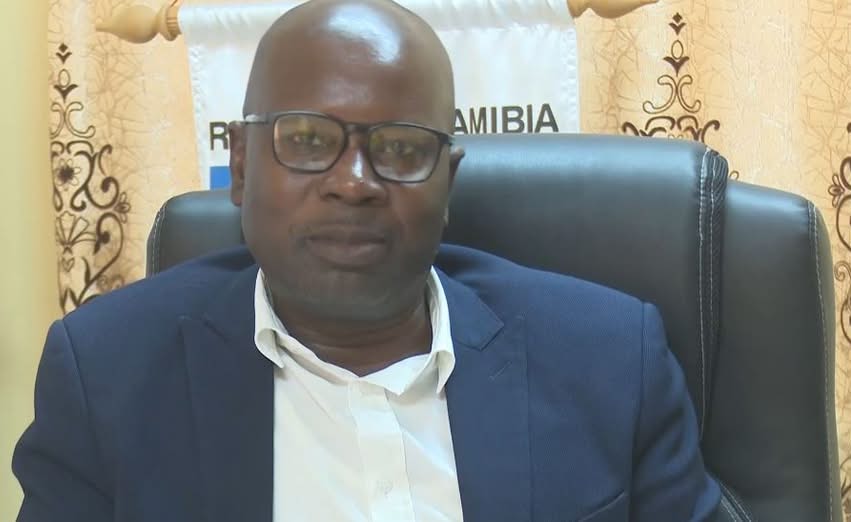
Zambezi Regional Director of Education, Innovation, Youth, Sport, Arts, and Culture, Mr Alex Sikume, has addressed the current state of education following the announcement of the 2025 examination results for Grade 11 (NSSCO) and Grade 12 (NSSCAS) in the Zambezi Region.
In an interview with Caprivi Vision recently, Mr Sikume clarified that for the Namibia Senior Secondary Certificate Ordinary (NSSCO), the Zambezi Region dropped from 6th position (in 2024) to 10th position in 2025.
For the Namibia Senior Secondary Certificate Advanced Subsidiary (NSSCAS), the Zambezi Region dropped from 7th to 10th position in the national ranking.
He attributed the decline to some schools whose performance has worsened. He added that Saint Kizito College, which was the best performer in the region, dropped from an average of 62.8% in 2024 to 58.8% in 2025.
Caprivi Senior Secondary School (CSSS) followed, with its performance declining from 56.3% to 45.5%. Ngweze Senior Secondary School secured third place, declining from 48.3% to 40.8%, while Mafwila Senior Secondary School’s performance also decreased significantly, from 51% to 38%.
SLIGHT IMPROVEMENT
He noted that some rural schools showed slight improvements, moving from lower to higher performance rates. For example, he cited schools that improved slightly, such as Masokotwani Secondary School (from 26.89% to 30.4%), Linyanti (from 15.8% to 28.8%), and Lusese (from 29.9% to 32.7%).
Mr Sikume revealed that the NSSCAS examination results also indicated a decline in performance for several senior secondary schools. Sanjo, previously the top performer, dropped from 85.3% to 78.8%; Kizito declined from 64.5% to 61.7%; and CSSS fell from 70% to 55.6%. In contrast, schools like Sangwali and Mayuni improved slightly.
When asked about the lack of teachers in Mathematics and Science in schools, and how the Ministry plans to cope with this situation in 2026, the Zambezi Education Director responded: “Yes, the region still faces the challenge of attracting qualified teachers, specifically in Physics, Chemistry, and Afrikaans. However, we usually recruit graduates from institutions of higher learning such as UNAM and NUST who specialise in these subjects but lack professional teaching qualifications. These teachers possess strong subject content knowledge but lack teaching methodologies, which is addressed through on-the-job training conducted by the Professional Development team and NIED. So far, all processed vacancies have been filled with qualified teachers; however, an advert that closed on Friday is still awaiting processing,” he explained.
He, however, dismissed allegations from parents that students were left without teachers for certain subjects.
“No school remained without teachers for the entire year; however, teachers are sometimes transferred to other regions or promoted. In such cases, the school notifies the Inspector so the post can be advertised. Unfortunately, at times, the teacher recommended for the post declines the appointment for one reason or another, in which case a second candidate is considered. The problem arises when only one candidate applies for a post, necessitating its re-advertisement. To mitigate this, the region has resolved not to transfer teachers during the term, and principals are encouraged to submit vacancies before the incumbent leaves, ensuring they can be filled before the teacher vacates.”
FULL RESPONSE
Free education in all government schools in Namibia is provided as per the Constitution, and recently, free tertiary education has also become applicable. In your view, how prepared is the Zambezi Region for the implementation of this initiative?
Free education has been in place since the introduction of grants to schools (UPE & USE). The Zambezi Region, like all other regions, has disbursed funds to schools as directed by the Ministry. It is not a new initiative; the new aspect applies to tertiary education.
The Namibian government recently announced and enacted a law stating that all school learners will no longer need to purchase stationery, as it will be provided (procured) by the State. What is your opinion on this policy, and do you view it as beneficial or detrimental?
It is a good initiative for school stationery to be provided by the GRN. The Ministry is obliged by the Constitution to provide education to all children. Funds for stationery procurement have been transferred. The Zambezi Region also received funds for schools to procure stationery. The amount schools procure with these funds is not sufficient for the entire academic year; therefore, we encourage school boards to engage parents to voluntarily support schools with the shortfall. This initiative is welcomed because some parents genuinely cannot afford to purchase all the required stationery.
Schools recently reopened for the 2026 academic year. What is the Ministry planning to do to ensure a better performance than that of 2025?
I speak at the regional level rather than at the Ministry level. The regional management has gone back to the drawing board to review the regional improvement strategies from 2025 and to revisit its approaches. We have identified some contributing factors, which I alluded to earlier, such as a shortage of teachers and late recruitment. We are embarking on performance dialogues with individual schools and will craft individual school improvement plans. We are intensifying our monitoring this year and will also involve parents to ensure expectations are clearly set. Learners will be engaged through motivational talks. Additionally, vacation and weekend classes will be implemented to ensure syllabus completion and revision.
There are still concerns regarding Grade 11 full-time repeaters among learners and from parents in the Zambezi Region. Could you explain the rationale behind these cases?
Grade 11 (NSSCO) learners who did not qualify for NSSCAS or tertiary institutions and are 18 years old or younger are allowed to repeat at the schools where they failed, provided space is available. If space is unavailable, learners are encouraged to register with NAMCOL to upgrade their results. So far, we have not received reports of repeaters not being admitted; such cases will be handled on merit.
Concerns have also been raised that many schools offer Grade 9, compared to fewer senior schools offering Grades 10, 11, and 12. What is your view on extending Grade 10 and Grade 11 classes in these combined schools to address issues of hostel accommodation and overcrowding?
There are 21 government schools (GRN) offering Grades 10-11 and 8 schools offering AS-level subjects. Combined schools outnumber secondary schools, but so far, we have been able to accommodate all our learners. There are plans to upgrade schools like Kongola to secondary status, and a modern school is currently under construction that will also offer the secondary phase. Currently, we are working on expansion plans for all circuits to accommodate curriculum growth.
ENDS.




 Loading …
Leave a Reply